ISO Class 6 vs 7 vs 8 Cleanroom Guide: HVAC Design & ACH
Selecting the wrong cleanroom classification can significantly impact product quality, regulatory compliance, and operating costs. An environment that is too clean may increase capital investment and energy consumption unnecessarily, while an under-designed cleanroom can lead to contamination, batch failures, product recalls, and failed audits.
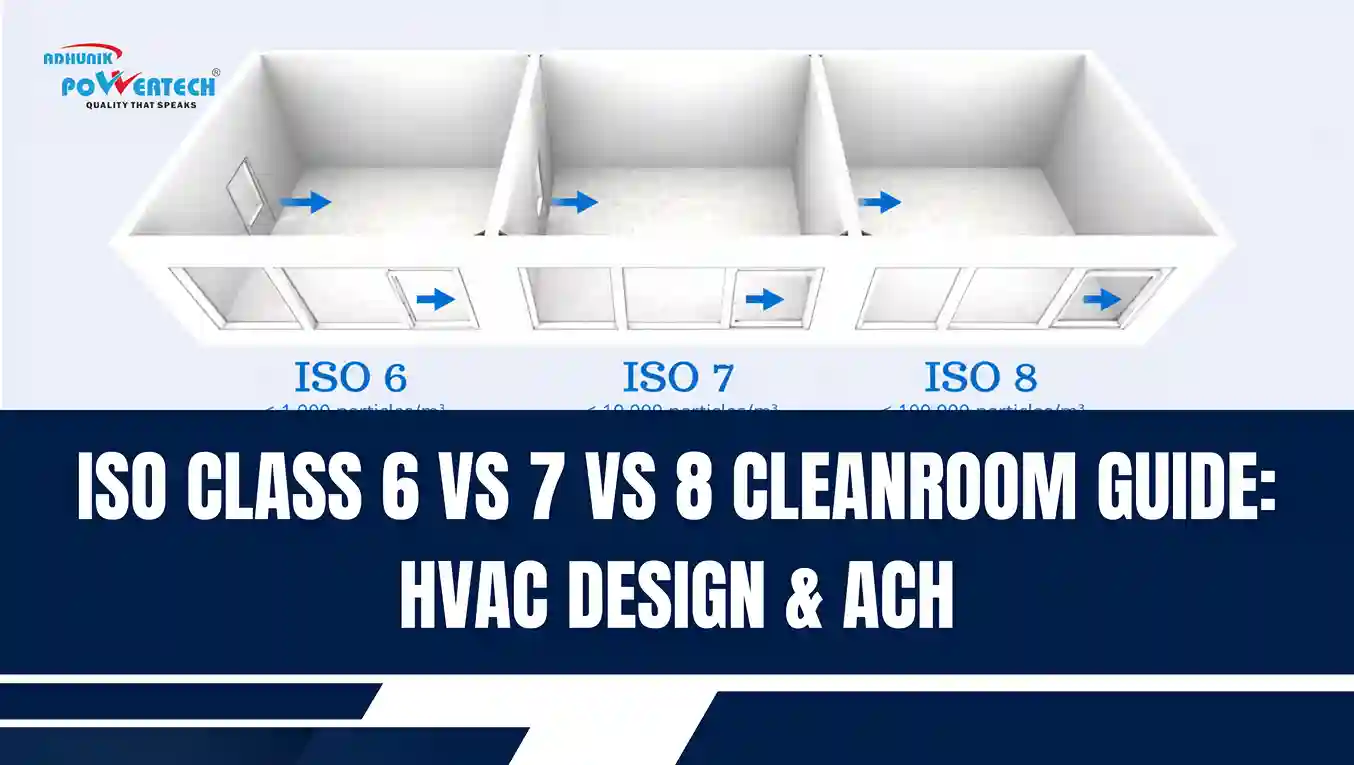
Cleanroom Classification & Architecture Systems
Explore the critical differentiators and structural requirements across major ISO classification levels to establish stable, compliant process spaces.
Choosing the right ISO cleanroom classification starts with proper HVAC planning. Since HVAC systems control airborne particles, airflow, pressure, and environmental conditions, understanding the differences between ISO Class 6, ISO Class 7, and ISO Class 8 is essential.
Defined under ISO 14644-1, these classifications help balance contamination control, compliance, energy efficiency, and operating costs. This guide compares their HVAC requirements, filtration, airflow, validation, and applications to help you select the right cleanroom for your facility.
What is ISO 14644-1?
ISO 14644-1 is the internationally recognized standard for classifying cleanrooms based on airborne particle concentration. Rather than evaluating microbiological contamination, it measures the maximum allowable number of airborne particles ranging from 0.1 μm to 5.0 μm.
The cleaner the environment, the fewer airborne particles are permitted.
ISO classifications are determined through certified particle counting performed under standardized testing conditions. These classifications influence every aspect of cleanroom engineering, including HVAC capacity, HEPA filtration, airflow design, room pressurization, and validation protocols.
What is an ISO Class 6 ?
An ISO Class 6 cleanroom provides a highly controlled environment where airborne particles are tightly regulated to support precision manufacturing and contamination-sensitive processes. Compared to ISO Class 7, achieving ISO Class 6 requires significantly greater HVAC performance, higher air change rates, and more rigorous environmental monitoring.
Typical Applications
- Sterile pharmaceutical manufacturing
- Semiconductor fabrication
- Biotechnology research
- Nanotechnology
- Precision optics
- Aerospace components
HVAC Design Requirements
Maintaining ISO Class 6 conditions demands an advanced HVAC system capable of delivering consistent airflow and particle removal. Typical requirements include:
- H13 or H14 HEPA filtration
- High-capacity air handling units
- Laminar airflow in critical production zones
- Tight room pressurization
- Continuous environmental monitoring
90–180 ACH is commonly required, depending on room occupancy, process equipment, and contamination risk.
ISO Class 6 cleanrooms generally maintain positive pressure relative to adjacent spaces to prevent contaminant ingress.
Typical operating conditions include Temperature: 20–22°C and Relative Humidity: 40–60%. Exact requirements vary according to the manufacturing process.
Advantages
- Exceptional contamination control
- Suitable for highly regulated production
- Supports critical sterile processes
Challenges
- High capital investment
- Significant energy consumption
- Intensive maintenance
- Frequent validation and certification
Day-to-Day Operations
Operating an ISO Class 6 cleanroom involves strict gowning protocols, continuous HVAC monitoring, scheduled HEPA integrity testing, routine particle counting, and disciplined maintenance to ensure compliance. Even small deviations in airflow or pressure can affect product quality and trigger corrective actions.
What is an ISO Class 7 ?
ISO Class 7 is the most commonly specified cleanroom classification across pharmaceutical, biotechnology, and medical device industries because it balances contamination control with operating efficiency.
Typical Applications
- Pharmaceutical manufacturing
- Medical device production
- Hospital compounding areas
- Biotechnology laboratories
- Electronics manufacturing
HVAC Requirements
Maintaining ISO Class 7 conditions requires a reliable HVAC system configured to ensure proper air cleanliness and balance:
- H13 HEPA filters
- Turbulent or mixed airflow
- Pressure cascade between adjacent rooms
- Dedicated AHUs with environmental controls
30–60 Air Changes per Hour
Consistent temperature, humidity, pressure differentials, and air balancing are essential for maintaining stable operating conditions.
Advantages
- Lower operating costs than ISO Class 6
- Meets many GMP manufacturing requirements
- Flexible for multiple industries
Challenges
- Requires ongoing validation
- HVAC balancing is critical
- Filter maintenance remains essential
A pharmaceutical tablet manufacturing facility may use ISO Class 7 cleanrooms for dispensing, granulation, blending, and compression areas, where contamination control is essential but ultra-high cleanliness is unnecessary. When planning complete facilities, integrating HVAC, architectural panels, utilities, and validation into Turnkey Cleanroom Solutions can simplify project execution and improve long-term performance.
What is an ISO Class 8 ?
ISO Class 8 cleanrooms provide controlled environments where moderate particle control is sufficient. Because cleanliness requirements are less demanding, HVAC systems are simpler and significantly more energy efficient.
Typical Industries
- Food processing
- Packaging facilities
- Electronics assembly
- Medical packaging
- Warehousing
- Hospital support areas
HVAC Requirements
Operating an ISO Class 8 environment utilizes simplified airflow and filtration specifications:
- H13 HEPA filtration where required
- Turbulent airflow
- Lower ACH
- Simpler ductwork and air balancing
10–25 Air Changes per Hour
Advantages
- Lower installation costs
- Reduced energy consumption
- Easier maintenance
- Flexible operation
Challenges
- Not suitable for sterile manufacturing
- Limited contamination protection for highly sensitive processes
Key Differences Between ISO Class 6, ISO Class 7 & ISO Class 8
| Parameter | ISO 6 | ISO 7 | ISO 8 |
|---|---|---|---|
| Particle Control | Excellent | High | Moderate |
| HVAC Complexity | Very High | High | Medium |
| Typical Particle Limit (≥0.5 μm) | 35,200 particles/m³ | 352,000 particles/m³ | 3,520,000 particles/m³ |
| Air Changes | 90–180 | 30–60 | 10–25 |
| Airflow | Laminar/Mixed | Turbulent | Turbulent |
| HEPA Requirement | H14/H13 | H13 | H13 |
| Energy Usage | Very High | Moderate | Lower |
| Installation Cost | Highest | Medium | Lowest |
The right choice depends on product sensitivity, regulatory requirements, occupancy, and lifecycle operating costs. Over-specifying cleanliness can increase energy bills without adding value. Organizations seeking regional expertise may also benefit from working with a Cleanroom Manufacturer in Haridwar that understands local configurations.
HVAC Design Considerations: Filtration
A layered filtration strategy improves system efficiency and extends HEPA filter life.
Capture larger particles before final filtration to extend the operating lifespan of high-efficiency filters.
Remove at least 99.97% of 0.3 µm particles and are standard in ISO Class 6–8 cleanrooms.
Used where even finer particle removal is required, such as semiconductor manufacturing.
Frequently Asked Questions
Is ISO Class 6 cleaner than ISO Class 7?
Why is ISO Class 7 the most common cleanroom classification?
Does every cleanroom require laminar airflow?
Conclusion
Choosing the right ISO Class 6, ISO Class 7, or ISO Class 8 cleanroom is about more than achieving the highest cleanliness level. It should align with your process requirements, contamination risks, regulatory standards, and operating costs.
ISO Class 6 is ideal for critical applications, ISO Class 7 offers the best balance of performance and cost for most pharmaceutical and medical device facilities, while ISO Class 8 provides an efficient solution for less demanding controlled environments. Selecting the right ISO class and HVAC design helps ensure compliance, reliable performance, and long-term operational efficiency.
Optimize Your Cleanroom HVAC with Expert Engineering
Connect to discuss the HVAC design, ISO classification, validation support, or turnkey cleanroom solutions & Get practical recommendations tailored to your facility and project requirements.