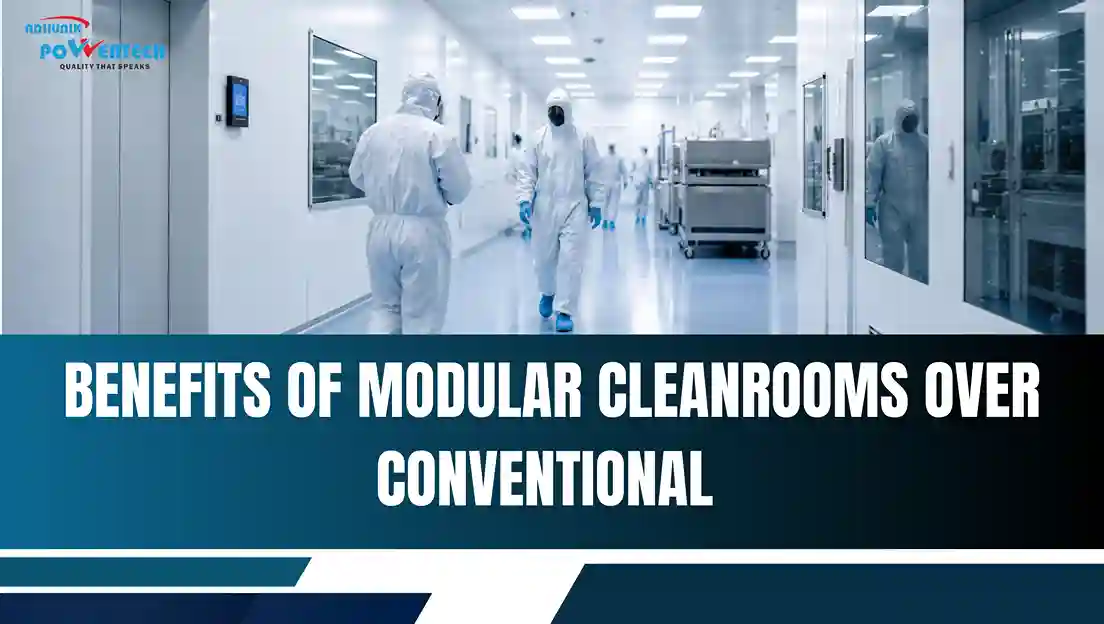
Benefits of Modular Cleanrooms Over Conventional Construction
Why More Manufacturers Are Choosing Modular Cleanrooms for Faster, Smarter Facility Expansion
If you're planning a new pharmaceutical facility, expanding a biotechnology laboratory, or upgrading an existing manufacturing area, one of the first decisions you'll face is how to build your cleanroom.
For years, conventional cleanroom construction was considered the standard approach. While traditional methods can still meet cleanliness requirements, they often involve lengthy construction schedules, higher labor costs, and limited flexibility when future modifications are needed.
Today's manufacturers operate in a very different environment. Product launch timelines are shorter, regulatory expectations are stricter, and businesses need facilities that can adapt as production demands evolve.
That's why modular cleanrooms are becoming the preferred choice across pharmaceutical, healthcare, biotechnology, electronics, and industrial manufacturing sectors.
Unlike conventional construction, modular cleanrooms are designed for speed, flexibility, and long-term efficiency. They allow businesses to create controlled environments that meet industry standards while reducing project timelines, minimizing disruption, and supporting future growth.
In this article, we'll explore the key benefits of modular cleanrooms over conventional construction and why more facility managers, project consultants, and manufacturing leaders are making the switch.
Understanding the Difference Between Modular and Conventional Cleanrooms
Before comparing the benefits, it's important to understand how these two construction approaches differ.
A conventional cleanroom is built directly on-site using traditional construction materials and methods. Walls, ceilings, utilities, and supporting infrastructure are constructed as part of the building structure itself.
A modular cleanroom, on the other hand, uses prefabricated wall systems, ceilings, doors, windows, and integrated services that are manufactured off-site and assembled within the facility.
Both meet ISO and GMP standards. Modular cleanrooms make expansion, upgrades, and compliance updates easier—with minimal disruption.
Key Advantages of Modular Cleanrooms
1. Faster Installation, Faster Production
For many organizations, the biggest challenge isn't designing the cleanroom—it's getting it operational as quickly as possible. Construction delays can affect production schedules, postpone regulatory approvals, and delay product launches. In industries where time-to-market directly impacts revenue, every week matters.
Because modular cleanroom components are manufactured off-site while site preparation takes place simultaneously, installation timelines are significantly shorter compared to conventional construction. Instead of waiting months for extensive construction activities to be completed, businesses can move into validation and commissioning much sooner.
2. Keep Project Costs Predictable
Unexpected costs are one of the most common concerns during construction projects. Traditional cleanroom builds often involve multiple contractors, extended labor requirements, and unforeseen site modifications that can impact project budgets.
Modular cleanrooms offer a more predictable approach. Because major components are engineered and manufactured before arriving on-site, project costs are easier to estimate and manage. Reduced installation time also lowers labor expenses and minimizes delays that can increase overall project costs. For facility owners and project managers, this means greater budget certainty and fewer surprises during execution.
3. Built for Future Expansion
One question every project team should ask is: "What happens when production requirements change?"
A facility that works perfectly today may require additional manufacturing space, new processing equipment, or expanded storage capacity within a few years. With conventional construction, modifications often require demolition, reconstruction, and operational disruptions.
Modular cleanrooms provide a much more flexible solution. Additional cleanroom areas, gowning rooms, laboratories, airlocks, and production zones can often be integrated into the existing structure with significantly less disruption. For growing pharmaceutical manufacturers and biotechnology companies, this flexibility can deliver substantial long-term value.
4. Minimal Operational Disruption
Many manufacturing facilities cannot afford extended downtime. Traditional construction activities often create dust, noise, and workflow disruptions that impact surrounding operations.
Modular cleanrooms help minimize these challenges. Since much of the construction work is completed off-site, installation activities are faster, cleaner, and easier to manage within active manufacturing environments. This allows organizations to continue operating while facility improvements are being completed, reducing the impact on production schedules and business continuity.
Quality, Compliance & Environmental Performance
5. Reliable Quality Standards
Cleanroom performance depends heavily on construction quality. In conventional construction projects, quality can vary depending on site conditions, contractor coordination, and installation practices. Modular cleanroom components are manufactured under controlled factory conditions using standardized processes and quality control procedures. This results in: Consistent panel quality, Better dimensional accuracy, Improved sealing performance, Enhanced surface finishes, and Reliable contamination control. The outcome is a cleaner, more dependable environment that supports long-term operational performance.
6. Simplified Compliance
For pharmaceutical, biotechnology, healthcare, and medical device manufacturers, compliance is non-negotiable. Facilities must often meet strict requirements related to: ISO 14644 Standards, GMP Guidelines, FDA Expectations, EU GMP Regulations, and WHO Compliance Requirements. Modern GMP-compliant cleanroom solutions are specifically designed to support these regulatory requirements through controlled airflow, contamination-resistant materials, pressure management, and validated environmental controls. Working with an experienced cleanroom partner can simplify the entire compliance process while reducing project risk.
7. Precise Environmental Control
A cleanroom's effectiveness depends on much more than walls and ceilings. Environmental control systems play a critical role in maintaining cleanliness, temperature, humidity, and pressure differentials. This is why properly engineered cleanroom HVAC systems are essential to overall facility performance. Advanced HVAC integration helps maintain: Stable temperature conditions, Controlled humidity levels, Required pressure cascades, Efficient airflow patterns, and Consistent particle control. The result is improved product quality, operational reliability, and regulatory compliance.
Long-Term Maintenance & Sustainability
| 8. Lower Maintenance Requirements Over Time | 9. A More Sustainable Construction Approach |
|---|---|
| Facility managers understand that maintenance costs continue long after construction is complete. Modular cleanrooms are designed with accessibility in mind, making routine inspections, repairs, and future upgrades easier to perform. Features such as removable wall panels, accessible utility pathways, and modular service integration help reduce maintenance downtime while supporting long-term operational efficiency. This can lead to lower lifecycle costs and improved facility reliability. | Sustainability is becoming an important consideration in facility planning. Compared to conventional construction, modular cleanrooms typically generate less material waste and require fewer on-site resources during installation. Many modular systems can also be reconfigured, relocated, or expanded without extensive demolition, reducing environmental impact while maximizing the value of the original investment. For organizations focused on sustainable growth, this is an increasingly important advantage. |
10. Stronger Long-Term
Return on Investment
When evaluating cleanroom options, the lowest upfront cost isn't always the best business decision. The true value of a cleanroom should be measured by its long-term performance, flexibility, maintenance requirements, and ability to support future growth.
These advantages often result in a stronger return on investment over the lifecycle of the facility.
Modular cleanrooms deliver value through:
Conclusion
The decision between modular and conventional cleanroom construction is no longer just about meeting cleanliness standards. It's about choosing a solution that supports operational efficiency, regulatory compliance, business growth, and long-term value.
For organizations seeking faster project delivery, greater flexibility, easier expansion, and lower lifecycle costs, modular cleanrooms offer clear advantages over traditional construction methods.
As manufacturing environments continue to evolve, modular cleanrooms are helping businesses build facilities that are not only compliant today but also prepared for the challenges and opportunities of tomorrow.
Let's Build the Right Solution for Your Facility
Whether you want a cleanroom consultation, get a custom cleanroom quote, or complete turnkey cleanroom solutions, our team is here to help you achieve full compliance and operational efficiency.